I wonder if, like the drain maintenance, Caltrans expects the City to pick up the trash and dumped furniture along El Camino? In this instance, maybe it's SamTrans responsibility?

I wonder if, like the drain maintenance, Caltrans expects the City to pick up the trash and dumped furniture along El Camino? In this instance, maybe it's SamTrans responsibility?
The CA Department of Transportation has opened it website soliciting comments on the proposed major changes to El Camino Real in B'game. The site is found here: https://ecralternatives.com/ We last touched on the project back in January here. The project has the potential to completely change ECR, so please click through to the old post and the official site and refresh your memory on what Caltrans has up its sleeve. The DOT notes that
There has been much progress since the scoping meeting in May 2020. We’ve completed a visual survey of the trees, studied many environmental resource areas, and worked with our design group to develop alternatives for the project. The next step in our environmental scoping process is to announce publication of the Caltrans Notice of Intent (NOI) to Prepare an Environmental Impact Report/Environmental Impact Statement (EIR/EIS).
Since we got a very modest amount of rain today, it was disappointing to see flooding reappear on ECR. The questions for B'gamers are do we really need to cut down all of the Blue Gum eucalyptus trees, bury all of the utilities (great idea but $$$$$) and approve the whole enchilada instead of trying one section to see what people who live here think? Or could we just fix the drainage and repave the surface? You have until December 17th to weigh in. Here is the April puddle on ECR hours after the rain stopped.

Big money has jumped into the Caltrain tax measure RR. We touched on the saga in May here and December here. The Daily Post reports that the yes side has raised $1.7 million dollars with recent funds from Google, Adobe, the Giants, Amgen and the usual developers and unions. The television commercials are running fast and furious and the in-fighting between SF, San Mateo County and Santa Clara County officials has moved off the front page. But the local letters to the editor are running strongly against handing Caltrain more money. The bike-rail commuters don't like how the bike cars were set up. The fiscal hawks can't believe management didn't make cuts during the worst days of Covid sheltering. And the equality folks complain that the passengers are generally more well-off than the general public so why subsidize them.
All this comes with a backdrop of cost of living/affordability concerns that may make the idea of more sales tax a hard sell. The late start due to the in-fighting may be enough to sink RR this time around. What a change from the pre-Covid predictions of growth from 65,000 daily riders in 2018, to 243,000 daily riders in 2040. If the high-cost rail albatross could be killed and plucked there would be more than enough rail money to go around the whole state.

The headlines read "Rough path for transit on horizon" (Chronicle), "Financial outlook for Caltrain is grim" and "Fears grow over delay of Caltrain electrification" (Daily Journal). Ridership is down about 90% and the line is looking at more than an $80 million budget deficit through FY21. It's hard to imagine getting on a crowded SRO train again, but it's easy to imagine many of the newly-minted work-at-home employees will continue at least some days. What to do?
During the meeting, officials said additional federal funding beyond the CARES Act will be needed as well as a dedicated funding source. A proposed eighth-cent sales tax for Caltrain in each of the three counties along the corridor is winding its way through the approval process for placement on the November ballot. Without new funding, furloughs and even a systemwide shutdown all become possibilities, officials said.
A hiring freeze has been implemented and overtime has been eliminated, to name two moves, and further reductions to service was also proposed. Even with the extremely low ridership of late, Caltrain is still running hourly service and a total of 40 trains a day, down from the usual 92 trains per day.
We noted the delays on the electrification program back in August when things were flush and the DJ is highlighting it again
According to John Funghi, chief officer of Caltrain’s Modernization Program, the foundation work is being paused this time because Balfour Beatty is running out of rebar cages needed for the job. That’s because Balfour Beatty failed to order more of them on time, Funghi added. To stay on schedule and complete the remaining 1,380 foundations by the end of the year, an average of 174 foundations must be completed a month. Caltrain Board Member Dev Davis claimed fewer than 50 foundations have been completed a month on average since the work began. But Funghi has argued monthly averages don’t provide the full picture as some months 50 foundations may be installed while other months are scheduled to see as many as 300 foundations installed.
Davis isn’t buying that argument. “John you have said that for the last three months at least, including two of the months where we had zero foundations,” she said. “I’m sorry but I cannot believe it any longer.
From the sounds of it, a lack of rebar is the least of Caltrain's problems right now. The sad thing is during all of the Board discussions being reported, nobody says "Hey, why don't we call the Governor and suggest he kill high-speed rail and use some of that money to prop up regular rail?" As I noted elsewhere, there are at least a few Assemblymen thinking along those lines, so why doesn't the Caltrain board jump on board? It would certainly add credibility to the November ask for more sales taxes to fund rail.
Since affordability is such a hot topic these days we should examine each and every effort to degrade our affordability. Gas taxes. Highway 101 fees. Natural gas bans in new buildings–or at least so far only new buildings–so we can spend oodles on electricity. School bonds and parcel taxes. More bonds for affordable housing. A sliver for the Rec Center. I'll bet some of the regular Voice commenters can remember some that I am missing. So here are the latest two– a slice for the train and a big bite on commercial property which is to say a big bite on brick and mortar retail. Amazon must be thrilled.
We do it all here at the Voice. Topics galore that go from intensely local to lessons learned from afar. Today's WSJ has an article about the early warning systems – plural – serving Mexico City. They have three. We Californians have a half of a system and nothing that reaches regular residents. Here's the lessons that I drew from the piece:
-A non-profit called Center for Seismic Instrumentation and Registry (CIRES) has the government stamp of approval, but two tech start-ups, Grillo and SkyAlert are taking a different, more digital approach.
-CIRES has 96 sensors on the Pacific Coast that feed a system that makes public announcements on TV, radio and public places with the idea of a one-minute warning.
-Grillo and SkyAlert want to send alerts via wireless networks to phones, Twitter and in-home alarms–in other words more immediate and personal.
-The choice of sensors is important to avoid false alarms with a choice between cheap Asian sensors and better Japanese sensors (I know, both are Asian, but Japan has been working on this problem for years.
The Local Angle: First, here is you reminder that the BNN Emergency Drill Day is coming up on October 12th. Last year's is described here. Find the closest one to you and join it. Second, if we are to be burdened with high-cost, high-speed rail, the least the Authority can do is spend a little of the $100+ billion on an early-warning system and interface the trains to it. You could argue Caltrain and Amtrak should also do that and they should, but they aren't doing 110 mph through densely populated areas.
For some reason, the SF Examiner lands in B'game driveways on Sundays. Maybe that is when the progressive rag makes most of its money off of real estate ads so they need to bump up the print run. This Sunday's edition highlighted that "Monitor warns of two-year Caltrain project delay" and then describes the back and forth between a federal monitor" and Caltrain about what constitutes a delay. The project arrived in B'game about a year ago as noted here. Here is a taste of the warning
“The overall progress of work is far behind the original schedule,” that oversight monitor warned. Foundation placement and the installation of the overhead electrical contact system are “far behind” initial projections, they wrote. But the federal oversight monitor wrote in a June report, “The Electrification contractor’s most recent Schedule Update Narrative for May 2019 shows a Substantial Completion date of March 3, 2022, compared to the contractual date of August 10, 2020, which represents a further slippage.”
Caltrain, for its part, said it is firm that construction is on schedule for 2021, with trains expected to be running by 2022. That date is also a change — Caltrain’s program plan initially showed the electrification project’s “substantial completion” marked for August 2020, but Caltrain acknowledged in its own project report that this date has slipped to September 2021. That project report is also not publicly available on Caltrain’s website, a break in common practice with other transit agencies, leading to concern from Caltrain officials. It is a public document. Instead, the report was provided to the San Francisco Examiner by a source under the condition of anonymity and became the heated subject of discussion at the Caltrain board’s meeting Thursday.
My least favorite part of the piece was the opening teaser line:
Caltrain’s soon-to-come electrified trains may one day whisk commuters from the South Bay to San Francisco with BART-like frequency, easing congestion on freeways and bolstering the local economy.
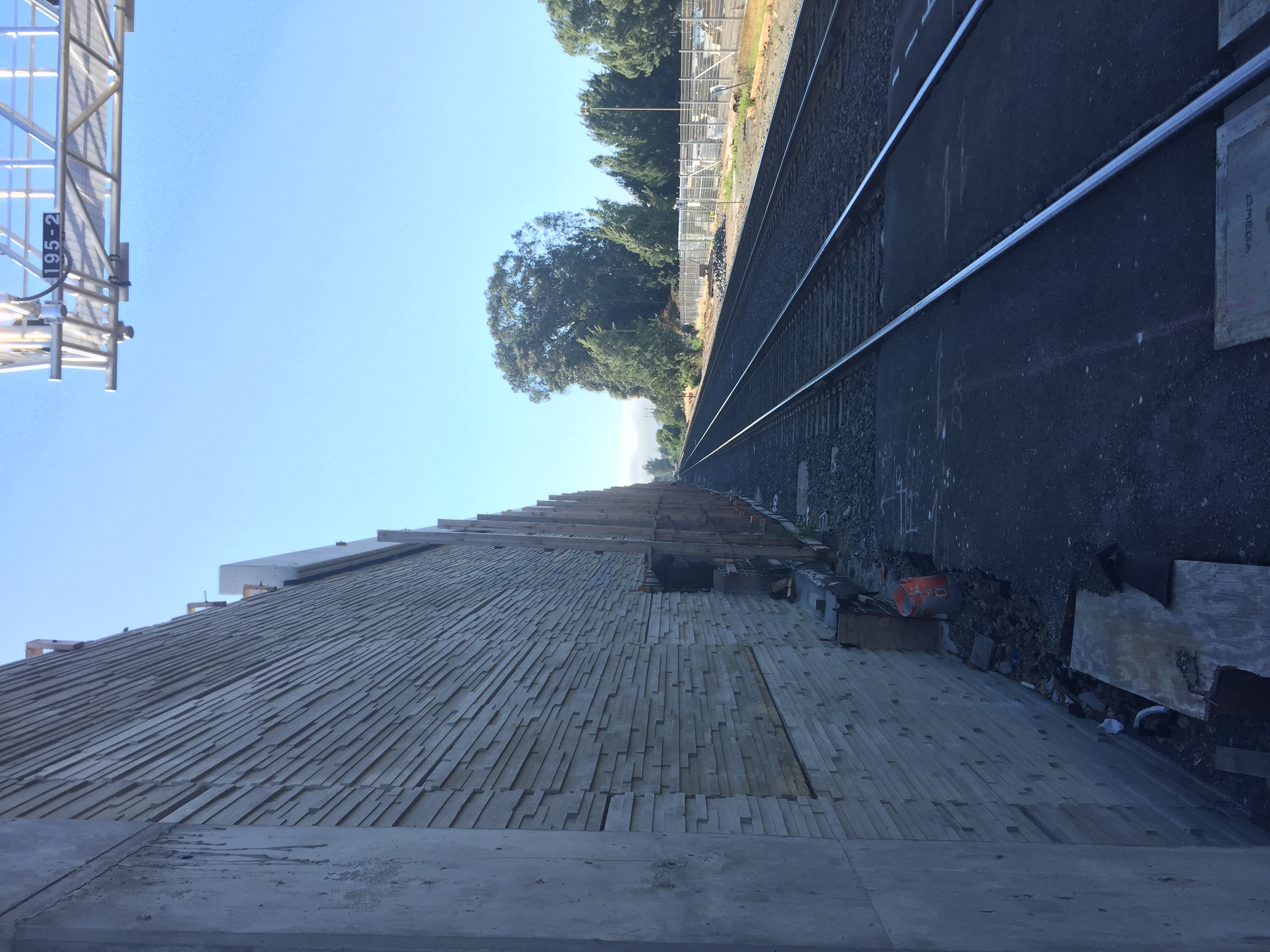
I'll get into this more later, but suffice it to say the ONLY two ways we will ever see BART-like frequency from Caltrain is if high-speed rail never reaches the Peninsula or if the budget and land-takings go up dramatically to add "passing tracks". There are some nice graphics from Caltrain-HSR reports that illustrate that. Once I find them I will share them, but intuitively we know this to be true. Imagine adding a local bus route around the Indy 500 brickyard track. But Caltrain is stuck–the money for electrification comes from high-cost rail so they have to button-up and press on. Here is the new wall in San Mateo at 25th Ave.– no room for a passing track there.
With the recent news about Caltrain, I have an opportunity to connect some dots – or at least try to connect some dots since they don't all fit very well. First we have the news that Caltrain ridership is down again. Mid-week ridership dropped for the sixth straight month and is down 2.3% this year compared to last year or down about 1500 boarding per week. In Monday's Daily Post our County supe, Dave Pine, was quoted as saying overcrowding maybe one factor. Sort of like Yogi Berra's old saw "nobody goes there anymore, it's too crowded."
Some other factors are a shortage of shuttle drivers for the last-mile connections to business parks and medical centers, the increase in pass prices, the wet winter, and according to Caltrain COO Michelle Bouchard "overall economic cooling"! Doesn't feel cooler out there to me. The second dot is the planning for capacity increases. Last Friday, the Daily Journal had a piece that you might be able to link to here if you haven't used up your free allotment for the month. The basic question is how many trains to add, how many stops to add with those additional trains and where might four tracks be needed to accommodate the increased frequency? The transit agency has been studying three scenarios for growth – "moderate", "baseline" and "high". High-growth equates to 2.5 to 3.25 times the recent mid-week ridership and would require more expresses and a local stopping every 15 minutes along the route–which in turn drives the need for four tracks. You have to wonder how Caltrain would pull off even modest lengths of four-track given the new housing developments immediately next to the right of way? We've seen it in San Mateo and San Carlos and there are more on the way.
The "moderate" scenario in Caltrain's 2040 vision would actually trim stops at the downtown San Mateo station from 70 to 58 while the baseline would drive 116 stops. The high-growth would need 196 stops and a number of grade separations to keep from completely snarling car traffic on the Peninsula- including ambulance, police and fire trucks. That's a lot of money that doesn't exist right now meaning that dot is hard to connect. And of course we have the specter of High-cost Rail running on the Peninsula. Money continues to be burned on high-speed rail planning even though there is no real plan to get through the mountains in either Northern or Southern California. The current thinking is that no new passing tracks would be needed on the Peninsula for HSR, but the confluence of moving parts makes that a tenuous decision at best. The hand-waving in today's Daily Journal piece was impressive. I think it's safe to say neither the local cities nor the County nor the State have a clue how train service will accommodate the needs of growth on the Peninsula. The dots are disconnected.

A letter to the Daily Journal reminded me of a longstanding discussion about having ferry service to the B'game Bayfront. A local resident named Orhan Kurt writes:
Regarding the idea of ferry terminals, my friends and I here in Burlingame are shocked to watch as Foster City aggressively pushes to be the regional hub and to be part of the upcoming Water Emergency Transportation Authority (WETA) study (June 17 edition of the Daily Journal).
Why does Burlingame wait on the sidelines? A regional hub should be right next to SFO. Burlingame has officially recognized the need and accepted the ferry hub concept for Burlingame as was approved in the latest general plan. So where is the follow-up Burlingame? Our own general plan consultants have encouraged us to connect the rail and SFO to the ferry system.
This seems like a) a no-brainer to decide to do and b) pretty easy given what we already have at the Bayfront right next to the Facebook/Oculus complex under construction. Check out this landing option that used to house The Sherman. Mr. Kurt may be expanding on what the General Plan says deep on page 154
M-4.8 Water-Based Transportation
Consider emerging water-based transportation options to improve multimodal access options to the Bayfront. [AC, SO}
But he's on the right track, or is it tack?
One of the common questions I hear in town is "When are they going to fix the rest of Broadway?" meaning now that the bridge has been replaced, what about the rail crossing? My standard response is "There isn't nearly enough money socked away to even start". That is the bottom line of a piece in today's Daily Journal recapping the discussion at Council on Monday. Here are my favorite tidbits, but do click through here to get all of the bits.
No decision was made at the meeting, as the issue was only discussed following a presentation from the county Transportation Authority, which allocates Measure A sales tax revenue for transit projects. The project is currently largely unfunded, and is expected to be completed by 2026, according to available financing. Examining the rising cost of construction, Transportation Authority officials anticipate the price will jump by about 35% over the life of the project, amounting to about $40 million more than the proposed current cost by 2026.
Although it is apparently considered the most-needed project in all of Northern California. Here's another gem
In a separate presentation, a Caltrain official said future service at Broadway will sap stops from the Burlingame station as well, as the proximity of the two stations will result in one train stop at either station every 30 minutes.
You mean like a real train service? Discussion of Mike Brownrigg's idea of not having a station at all at B'way (ostensibly to shorten the Giant Wall Dividing The City) raised the other council members' hackles. With massive residential development at the Anson apartments on Carolan and Facebook coming along with whatever goes in on the State Lands Commission property (see the next post below), one would think we would want more train service at B'way. Anyway you look at it, there's not enough money floating around to do much of anything for years.
Dedicated to Empowering and Informing the Burlingame Community
The Burlingame Voice is dedicated to informing and empowering the Burlingame community. Our blog is a public forum for the discussion of issues that relate to Burlingame, California. Opinions posted on the Burlingame Voice are those of the poster and commenter and not necessarily the opinion of the Editorial Board. Comments are subject to the Terms of Use.
All content subject to Copyright 2003-2026