Category: SamTrans-Caltrain

  • After seeing multiple Waymo's in my neighborhood for a month or more I decided it was time to give it a try.  I actually like to drive especially with my manual transmission cars.  It's a control thing and that ain't Waymo.  But we were four and planned on having a nice dinner in Millbrae, so I hailed one.  It was prompt arriving when it said it would, but missing the pick-up location by four addresses–so we walked over to it since you can't wave at it.  Out to ECR, left turn and headed north it was very careful and direct.  It changed lanes oddly for no apparent reason although my friend noted maybe its suspension sensor guided it away from the right lanes that SamTrans and trucks have turned into a used-up mine field.  $18 seemed about right–no need to tip the driver.

    Drop-off was smooth and after dinner the pick-up was also smooth–like a Lyft.  Then the fun started.  Instead of going 75 feet, turning right on ECR and heading for B'game it made an inexplicable turn back to the Millbrae neighborhoods.  It made another five inexplicable turns on tight residential streets until finally getting to ECR.  Being in good moods we laughed at it.  Then the drop-off (supposedly back where we started) went South as they say.  It turned left instead of right and stopped several blocks from home on the other side of ECR. That was it.  Get out.  Live customer support came on the speaker promptly and indicated the drop-off was outside the service area!  She didn't know what to say when I told her it picked us up there two hours ago, but the fare was waived.  Very odd.

    Today's announcement that Waymo is cleared to start driver-assisted service into SFO made me think that one should leave plenty of time since a random walk through the neighborhood could add fifteen minutes to the trip.  I will improve, it's just not quite there yet.  Here's me on ECR.
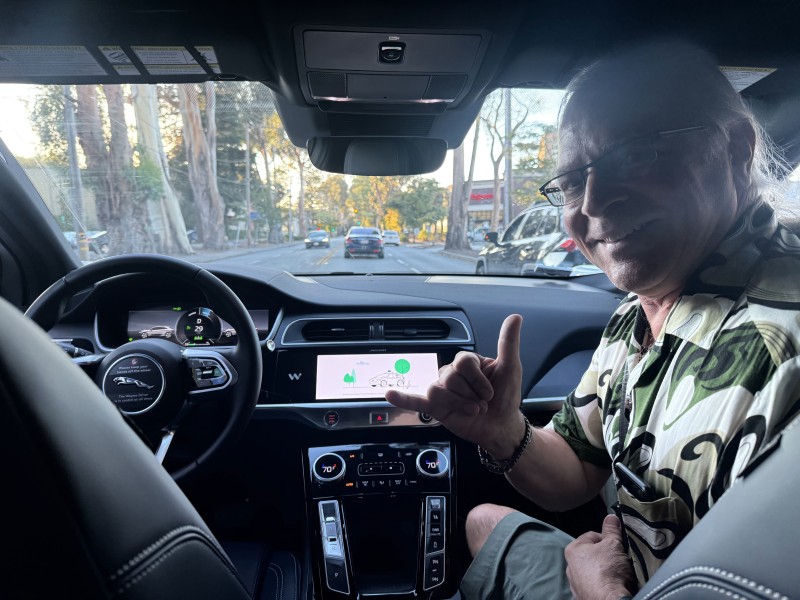
    Waymo Joe_jpg

  • You can love BART, or you can ignore BART unless the agency starts dipping further into your pocket.  As a County we now pay $4 million a year, but the proposed tax increase would up that to $35 million–and still not solve the systemic issues with "transit" across the board.  The Merc is highlighting the Papan, Speier and Mueller opposition to the current proposal.  Even with more governance participation, most of the County would rather see Caltrain propped up than subsidize BART.  Per the Merc piece today, the tax has 54% approval but recall from eighteen months ago the support assumes somebody else will pay the freight.

    San Mateo County officials are clashing with the state lawmakers over a proposed regional sales tax that would bail out the Bay Area’s distressed transit systems, arguing that their constituents would shoulder an outsized share of the burden without a fair say in how the money is spent.

    The debate has complicated negotiations around the bill, SB 63, which would allow voters to impose a half-cent sales tax in Alameda, Contra Costa, San Mateo and Santa Clara counties, and a full cent in San Francisco. The tax could raise up to $1 billion annually over the next 14 years for BART, Caltrain, San Francisco’s Muni and other agencies facing steep budget gaps as federal and state relief funds dry up.

    At issue is San Mateo County’s lack of representation on BART’s board, which is made up of elected representatives from San Francisco, Alameda County and Contra Costa County. Together, the three county’s residents pay some $392 million in sales and property taxes toward the system, which make up nearly 40% of its total operating revenue. Meanwhile, San Mateo County contributes just $4 million annually.

    If voters pass the measure, San Mateo residents could be on the hook for roughly $35 million a year, about 10 percent of the sales tax revenue earmarked for BART.

    The sales tax could be placed on the ballot either through an action of the commission or through a qualified citizens’ initiative. The bill’s sponsors are hoping to take the latter route, as it would require a simple majority to pass, versus a two-thirds vote if placed on the ballot by MTC. Polling has shown that 54% of voters across Alameda, Contra Costa and San Mateo would vote yes on such a measure.

    These "qualified citizens' initiatives" are always suspect and this one feels even more suspect than most.

  • Long time B'gamers will recall Rosalie O'Mahony's long tenure on city council and many of her fervently held positions.  I can clearly recall her somewhat high.jpgtched voice and slight, but hard to decipher accent.  I can also recall one of her favorite sayings, "Never sell schools or parking lots".  When the school district sold–and then had to repurchase—Hoover school, they learned Rosalie's lesson.

    It appears our current city council is about to contravene Rosalie's wisdom in order to pay for the pricy new city hall plan at 1440 Chapin Lane.  Parking Lot H is across El Camino from Walgreen's and is 39,922 ft2 according to the staff report.  It's composed of two lots:  8,500 ft2 zoned R-1 and 24,422 ft2 zoned R-3.  The city has declared both "surplus land" which probably has Rosalie turning over in her resting place.  The staff report notes

    The City owns several parking lots in and around Downtown Burlingame. While Parking Lot H is utilized by residents as well as customers and employees of local businesses, it is not frequently as full as other City owned parking lots. Further, while other City owned parking lots are surrounded by commercial properties, Parking Lot H is surrounded by single and multi-family residential properties.

    Notice the report doesn't actually say how full H is on a typical day.  I pass by it on a daily basis and it gets a decent amount of use.  My guess is Avenew employees are regular users so we should not discount its value as a long-stay overflow lot.  Customers want to park in front of the business they intend to patronize so having employees leave the close spaces open has value.  It is also convenient to a couple of SamTrans bus stops for people looking to make a hybrid car/bus trip.

    The lot directly between Walgreen's and Safeway is quite full as are the one next to the AT&T building.  The library lot is usually quite full.  The new parking garage is too far away to be considered by anyone using Lot H.  This train has probably left the station, but I would listen to Rosalie and not sell–especially when you feel like you have to and interest rates are up.  Any developer will also have to consider how long and disruptive the Little Big Dig will be on El Camino.  Here's view from the roof of Safeway.

    Parking Lot H

  • It was fun reading SF Comicle journalist Rachel Swan try to put a happy face on the latest PR from the High-Speed Rail Authority.  As the Feds meander towards cancelling the latest $4 billion check, the latest CEO thinks private money may participate!  From the Chron

    At a moment when California high-speed rail faces possible abandonment, the project’s new CEO sees a tantalizing lifeline: $1 billion annually from the state, supplemented by an infusion of private capital.  It’s a hopeful, perhaps heady proposition.

    More like a head shop proposition, but she's trying

    But when CEO Ian Choudri was appointed last August to run the High-Speed Rail Authority, an agency created to plan and oversee the train system, he refused to let rising costs or critics distract him. Instead, he latched onto the public-private financing gambit, convinced that it just might work.

    Here's another guy looking to eat at the trough

    “There are significant ways to monetize (and) commercialize long linear rights of way,” said Sia Kusha, senior vice president of Plenary Americas, a firm that specializes in public-private partnerships. Plenary has helped build metro rail systems, hospitals, freeway express lanes and a vast expansion of the UC Merced campus.

    Although Kusha did not provide specific details about how to commercialize high-speed rail, others cited the fare box as a basic source of revenue. Beyond that, companies could develop real estate around stations or operate tunnels and charge for every train that rolls through. For businesses willing to engage in a little magical thinking, the opportunities seem boundless.

    "A little magical thinking"?  Is that like being a little pregnant?  You can tell Rachel had a deadline, went to the conference where this nonsense was discussed and had nothing else to write about.  The sooner Newsom kills this boondoggle and redirects the $1 billion per year of Cap and Trade money to things like, say, the Broadway grade separation, Caltrain and SamTrans budgets, or even propping up BART, the better.  Nobody has said this, but there's a non-zero chance that the El Camino Real "Little Big Dig" might be seeing cost increases that threaten the project the same as the grade separation.  Even that would be a better use of money than the Train from Nowhere to Nowhere.

  • John Kevranian of the Broadway BID is raising the issue of full, weekday service being restored by Caltrain at B'way.  We can go back in time to August of 2015 when the tenth anniversary of the weekday closure happened here.

    It's been 20 years, but John has the institutional memory of what was promised and now wants to call in the chips.  It's going to be a bit of an uphill battle, but with the electrification and the quicker start/stops, now is the time.  Here is his letter to the DJ

    It is time for Caltrain and the city of Burlingame to reopen the Broadway Burlingame Caltrain Station for weekday service. There is no money to do the grade separation. Seventeen years ago, when Caltrain decided to close the weekday service at the Broadway station, It devastated the small businesses in the Broadway business district. On average, over 2,000 people would take the train every week. Passengers would walk through Broadway, grab their coffee, breakfast and take the train to go to work. In the evening, passengers would get off the train, grab their dinner, groceries and other essentials and walk home. The Broadway business owners and the Burlingame Community were promised that when the Caltrain electrification was completed, it would reopen the weekday service.

    Surrounding the Broadway District are thousands of apartments and many new developments that are happening very near Broadway station. Many biotech businesses around Bayshore are in the development stage and were told that Broadway station would reopen its weekday service once electrification was done, in order to facilitate their employees' commute. Two apartment complexes consisting of over 800 units are steps away from Broadway Caltrain.

    Reopening the Broadway station will not cause an additional safety or traffic issue. The Broadway station platform would be extended an additional 50-100 feet closer to Carmelita Avenue and once the train crosses the gates, the gates would immediately open. This is not difficult engineering. Caltrain has to service the needs of the Burlingame Community.

    John Kevranian

    President, Broadway Burlingame Business Improvement District

    The letter is buttressed by outreach to KRON 4 news who came to B'game for some interviews you can watch here.

  • Lewis Carroll would resonate with current California politics since we are in an Alice in Wonderland upside down world.  Just look at how CEQA – the California Environmental Quality Act– has become a hindrance that needs to be dodged.  The DJ notes:

    Senate Bill 71, sponsored by state Sen. Scott Wiener, D-San Francisco, would extend exemptions for agencies like Caltrain from the California Environmental Quality Act for a myriad of projects.  CEQA typically necessitates detailed, often time-consuming, environmental reviews and impact reports. The current exemption is set to sunset in 2030.

    “The main interest we have in this bill is that it would remove the current sunset date … for a host of CEQA exemptions for transit projects,” Devon Ryan, officer of government and community affairs at Caltrain, said. “That does implicate a lot of things on the Caltrain-owned corridor, and we would be supportive of the continuation of this exemption.”

    They pulled this eleven years ago as covered here.  It's not like the rest of the activities and projects on the Caltrain corridor are running so smoothly regardless of CEQA requirements.  Just look here.  And it's not just Weiner poking at the heretofore revered law.  Newsom is doing the same thing in Pacific Palisades and Altadena.

    Who would have thought that the "evil developers" would end up being elected politicians?

  • It is one thing to believe someone cannot put two and two together and get four.  It's another to see them demonstrate it in front of 300 people in a hotel ballroom.  Last week the Burlingame/SFO Chamber of Commerce held its annual meeting at the Hyatt and added something new–a panel discussion with three local politicians.  The panel, moderated by City Manager Lisa Goldman, included B'game mayor Peter Stevenson, Diane Papan's District director David Burruto and San Mateo County Supervisor David Canepa.  Each had an opportunity for an opening remark.

    Canepa started enthusiastically by highlighting how he travels all over the country and the world and people constantly tell him how much they love San Mateo County.  How lucky we are to live here and how many of them would like to do the same.  And it's more than just our fabulous weather.  It was a glowing opener and something many of us also experience, especially if we get more specific and mention B'game.  Canepa then proceeded to talk about our "housing crisis" and how we need to build a lot more affordable housing, so people and businesses stop leaving the county.  The notion that we cannot outbuild the global demand to live here that he just described never actually occurred to him.  It was remarkable.  It would have been great to ask, "exactly how much new, affordable housing we should build?"  5,000 units?  Should we accommodate a doubling of the county population (about another 750,000 people?) Should we triple it?  Should we perhaps address some of the other areas that go into the total cost of home ownership–some of which he might actually be able to do something about?  Should it all be "stack and pack" cellblock designs so it will be "affordable"?  That would have been fun.

    Given it was only a 20-minute talk, Lisa Goldman only got to ask one additional question out of a big pile submitted by the audience.  She did a quick tally and determined that about half were asking about the Broadway grade separation.  All three panelists responded.  I listened closely.  There was mention of "close coordination", "better communication" between agencies, "making it a priority" and the challenge of working around "electrified Caltrain".  In other words, five minutes of bobbing and weaving because there is no viable plan to deal with the new, bigger cost estimate.

    Here's the panel at work.  Lunch was good.

    Chamber panel_012325

  • The song remains the same on the grade separation at Broadway only a lot more off-key than before.  I wrote this five years ago here:

    One of the common questions I hear in town is "When are they going to fix the rest of Broadway?" meaning now that the bridge has been replaced, what about the rail crossing?  My standard response is "There isn't nearly enough money socked away to even start".

    That refrain got even worse this week as the DJ reports:

    The grade separation — designated as a top priority at last year’s city goal-setting — would separate the train tracks from the road to mitigate traffic, increase public safety and allow more than one train at the Broadway station. At the beginning of 2024, project costs were estimated at $325 million.

    Now, however, Caltrain recently informed the city about significant increases to project costs, raising totals to $500 to $600 million for construction alone, Public Works Director Syed Murtuza said.

    Aside from the usual, completely predictable, extreme increases in the cost of labor and materials, now we get to add the fact that with electrification of Caltrain we have to de-electrify the lines to do the construction for four hours at night.  Less construction time equals more project time equals higher costs.  Rinse and repeat.

    Pleas from the city to complete the grade separation before Caltrain electrification went unanswered, Murtuza said. “It’s just utterly poor management and mismanagement on the part of the organization, and we saw it directly,” (Donna Colson) said.  She urged the city to realistically communicate with residents about the realities of the long-awaited project moving forward.

    "Realistic" is our middle name here at the Voice.  No shovels will be hitting dirt in the foreseeable future, so we need to make lemonade.  Is it AI like noted here?  Is it just an underpass?  Do we try to get a reprieve from the state on our RHNA numbers so we can stop building giant residential cell blocks on Rollins that will change the traffic grade on the intersection from an "F" to an "F–"?   Just kidding, not "realistic", but a nice fantasy.  There are timing tweaks to the various signals that could make marginal improvements.  All we can really do is better traffic enforcement and hope the accident and fatality rates don't climb.

  • The calendar has turned over to 2025, but things are not improving on El Camino.  I just happened to make the round-trip from the southern edge of B'game to the northern edge and it's a mess.  Due to the New Year's mid-week holiday, the delivery trucks (Amazon, UPS, FedEx, Sysco, etc) are clogging up the traffic flow by taking the right lane away.  Nothing new there.

    What is new is how many new potholes have appeared.  Some blame the rains.  Some blame the prior poor patch jobs.  SamTrans buses pounding the pavement?  How about all of the above.  My less-than-scientific wild guess is there are about 400 potholes on our section of the King's Road.  The King should be ashamed of himself.  Maybe Caltrans is thinking why fix anything when we are planning to tear it all up anyway, but the section just south of B'game in San Mateo isn't any better.  Here's a reminder that somewhere on ca.gov you can ask for money to repair damage to your car from the road.  I've never tried it, but I hear it is possible.  In the meantime, we all suffer with the Peasant's Road.  Here is the new emblem of ECR that replaces the Mission bells.

    Hubcap hell


  • For all the talk about our "housing crisis", there is little media or politician discussion about what makes housing expensive here or many, many other places.  The build-our-way-out of it people, like the YIMBYs, just focus on the four walls.  As the letter writer below noted, it's tiresome.  It's also myopic.  The WSJ chimes in today with a piece titled "Insurance and Taxes Now Cost More Than Mortgages for Many Homeowners: Ballooning expenses rewrite the math of homeownership".  The piece zeroes in on home insurance, flood/fire insurance, property taxes and home repair costs and shows

    These ballooning expenses are rewriting the math of homeownership. In September, 32% of the average single-family mortgage payment went to property taxes and home insurance, the highest rate ever for data going back to 2014, according to Intercontinental Exchange.  For a small but increasing share of households, the burden is far more significant. In five major metro areas—Rochester and Syracuse, N.Y.; Omaha, Neb.; New Orleans and Miami—at least a quarter of borrowers spend more than half their monthly mortgage payment on taxes and insurance, according to ICE. 

    These metro areas have high property taxes or pricey home insurance relative to typical home costs, or both.  Nationwide, taxes and insurance make up more than half of the monthly mortgage payment for 9% of single-family mortgages. That is up from less than 4% at the end of 2014. 

    Left out of the equation because of how the study gathered data are the other costs–electricity, natural gas, garbage, sewer/water and bond measures for schools and anything else the politicians can dream up (looking at you Caltrain and sea level rise).  A major variable will always be interest rates, but all of these other factors just pile on and increases get waved through regularly.

    One could even argue the YIMBY mentality will make it all worse.  More grid, more water, more sewage treatment, more classrooms, more, more, more.  Decarbonize your house in the next 10 years?  That won't be easy or cheap as we noted here.  Looking at all of the costs in total reveals the real story–not the faddish one.

The Burlingame Voice

Dedicated to Empowering and Informing the Burlingame Community


The Burlingame Voice is dedicated to informing and empowering the Burlingame community.  Our blog is a public forum for the discussion of issues that relate to Burlingame, California.  Opinions posted on the Burlingame Voice are those of the poster and commenter and not necessarily the opinion of the Editorial Board.  Comments are subject to the Terms of Use.


All content subject to Copyright 2003-2026