Category: Bayfront Development

  • The Chronicle is running a second story today as the "algal bloom" spreads throughout the Bay.  In yesterday's print edition there was a photo of a dead sturgeon at Coyote Point.  It was about two feet long.  The Chron notes

    While scientists can’t yet pinpoint an exact cause of the bloom, which first began in late July, the fish kills are a sign that it has grown in intensity. It’s also become very noticeable, with the bay’s maroon-brown tint visible to motorists from the Bayshore Freeway or Bay Bridge and an estimated thousands of dead fish piling up near shore.

    An intrepid Voice reader sent along a much better photo of the bloom on our bayfront and reiterated how much the whole thing stinks.  Check it out.

    Algal bloom Bayside

  • Most of the graffiti around town is ugly and indecipherable.  Here was an example from last month that was both before it was painted over.  While it's all illegal, every once in a while, a real artist drops a bit in a less objectionable location.  This example is on the side of the raised roadbed over by the entrance to Coyote Point as you turn towards the Humane Society.  You can only see it if you are headed out of the park and look down.  It gave me a laugh.

    Fred grafitti

  • Two tidbits of B'game real estate news came in today from Zumper and the County assessor's office.  First the Zumper rental update shows B'game in the middle of the pack at $2,300 for a one-bedroom–up 1.82% year-over-year.  Two-bedrooms were a bit of a surprise with average rent off 11.6% at $2,830.  That's the only noticeable decline of all 20 cities surveyed.  Not sure what is going on, but the wave of For Rent signs on El Camino has subsided a bit yet there are still many available.  It's a good thing we don't have rent control.

    On the assessed property value side, the DJ is reporting

    San Mateo County’s property assessment roll increased year over year by $22.2 billion, or 8.34%, to a record high of over $288 billion in assessed value, San Mateo County Assessor Mark Church announced Tuesday.  San Carlos had an increase of 12.64%, South San Francisco was up 12.53%, Burlingame saw a hike of 10.77%, Millbrae increased 9.43% and East Palo Alto was up 9.29%.

    The property tax revenue generated is approximately 1% of the annual property assessment roll and this year will increase to $2.88 billion. Approximately 45% of the revenue will go to schools within the county, 25% to the county, 18% to cities, 10% to special districts and 2% to former redevelopment agencies.

    One factor in the growth of the San Mateo County secured roll is new commercial development. In all, 64.6 million square feet of new construction are expected to be completed in the county over the next six to eight years. A total of 9.12 million square feet are under construction, 13.9 million square feet have planning approval, and 41.6 million square feet are under review. Approximately 17 million square feet of new construction have been completed in the last five years, according to the Assessor’s Office.

    That puts numbers to our collective amnesia about the drought.  And who knows, a lot of this new real estate may be underwater as John Horgan notes in his column:

    According to Dave Pine, chair of the OneShoreline Board of Directors and a member of the county’s Board of Supervisors, projects to counter climate change along the shore could take decades to finish.  And, even then, they might not be enough to ward off the worst aspects of what could be coming. “This will take generations,” he predicted.  To that end, OneShoreline and the county are examining the need for an ultralong-term parcel tax to help to finance the myriad construction efforts under discussion.

    You knew where that was headed, right?

  • Brick and mortar retail got a boost today–just not on the Avenue or B'way.  Meta (aka Facebook) has announced a shop at the old Drive-in location and  The Registry is regurgitating the press release:

    Today, we’re announcing Meta Store — our first physical retail space, which will open May 9 on our campus in Burlingame, California. In the Meta Store, you’ll be able to get hands-on experience with all our hardware products. 

    Through interactive demos, you can make video calls to retail associates with Portal, learn how Ray-Ban Stories can help you stay present with the world around you, and explore the magic of VR with a first-of-its-kind immersive Quest 2 demo. 

    The Meta Store also features an interactive Quest 2 display wall, allowing you to explore the hardware, its accessories, and the breadth of content available today. Last but not least is our immersive Quest 2 demo area, where you can try Beat SaberGOLF+Real VR Fishing or Supernatural on a large, wall-to-wall curved LED screen that displays what you’re seeing in-headset. You’ll also get a 30-second mixed reality clip of your demo experience that’s yours to share.

    Starting May 9, the store will be open Monday through Friday from 11:00AM to 6:00PM PT. It’s located at 322 Airport Blvd in Burlingame, California.

    It looks a lot more interesting than the Amazon store on the Avenue.  Hopefully they move a lot of product and generate a lot of sales tax for B'game.  I do wonder if they designed the parking structure to account for a retail space with non-employee parking access since all of the parking is in the structure.  While we wait for Top Golf out on the Bayfront, GOLF+ may be the next best thing.

    May 25 Update:  I stopped into the Meta store today to have a look.  There's plenty of staff to give you a tour of the Rayban smart glasses and the Portal device.  The glasses are kind of cool and maybe a bit spooky with the dual cameras and video capability.  The Portal looks to be well-designed with more capability than the competition.  It's already a year old (a long time in consumer electronics) so probably wait for v2.  The virtual reality demo requires an appointment, so plan ahead.  Not the most obvious location, so use this photo and the signs to guide you.

    Metaverse store1

  • A comment on the Year in Crime: 2021 post reminded me to double back to the question of whether or not we put in license plate reading cameras in B'game.  According to the DJ article, in a rare split decision, councilors Ortiz, O'Brian and Colson went for the idea while Brownrigg and Beach were opposed.

    Burlingame is one of just four cities in the county that has yet to approve the cameras (Ed: that means 16 already have them), according to Police Chief Mike Matteucci, who added he believed they would be beneficial in the city. Others on the Peninsula have turned to the cameras in hopes of stopping auto burglaries near hotels or retail crime. 

    Matteucci said implementation in Burlingame would likely consist of two-dozen or more cameras installed at entry and exit points to the city and major intersections. They could also be affixed to police vehicles. 

    You will recall from the Year in Crime: 2021 post that vehicle burglaries were up 25% year over year to 25 per month–basically everyday someone gets burgled.  And that number may or may not include the catalytic converter thefts–I've asked BPD for some numbers on that really expensive crime (~$2,800 to replace, keep your insurance current).  At least one reluctant councilmember wants to "see the data".  I would suggest that all council members should be reviewing the data regularly.  Heck, I would make it a regular council agenda item, but that's just me.

    Brownrigg, however, said he was unconvinced Burlingame had a need for the cameras and expressed reluctance to increase surveillance or traffic stop frequency in the city.

    “Any time we permit greater surveillance, especially using technology, we need to have a use case that justifies it, so I would like to see that data,” he said. “I’m not saying our decision will change the big forces of technology, but this is just one step along the path to facial recognition, it’s one step along the path to cameras everywhere.”
     
    I'm not going to give much airtime to the concern about racial profiling–everyone license plate colors are the same.  We shall see if this goes anywhere or if higher political ambitions derail it.
  • Thousands of New Homes2

    I’m very excited by the impending housing growth in North Burlingame that will end up bringing “thousands of new homes” to the Rollins Rd. industrial section of town.  The amount of planning that went into this decision by state and county officials, the City Council, the Planning Commission and city staff is impressive.  Here are the details:

    Water:   I know the decision makers have a grasp on our dire water situation because they said so back in May  calling it “alarming”.  They also know the SFPUC cannot be trusted to keep the Peninsula’s water interests front-of-mind regardless of whatever “contract” we have with them, so the negotiations with the state to gain access to Bayfront land for our new desalinization plant (instead of a park) are to be complemented.  Desalinized drinking water is about ten times as expensive as water agencies buy now due to the energy costs.  Then there is the cost of getting rid of the brine, but the free land access will help the economics.  The new water tank on Rollins will ensure reliable water for the new neighborhood.

    Outflow:  In the spirit of “what goes in, must come out”, the city study on sewage treatment capacity at the Bayfront plant will probably find a need for additional capacity, but we can be sure that raising the sewer rates to pay for it will be easy as we just saw this year.  Burlingame is a welcoming community, so higher rates will be fine with the public.

    Power:  The decision makers’ extensive negotiations with PG&E to get it to strengthen the Burlingame grid are to be complemented.  Not only will the grid improvements supply the new desalinization plant’s load, but it will also ensure grid stability for the rest of the city.  Generous state and federal funding for new solar panels on the new construction and some existing Rollins Rd. buildings will help; as will a brand new grid-based battery facility.  Whoever got that big grant should get a promotion.  The natural gas pipes should be fine since there won’t be any natural gas allowed.

    Schools:  Given the thousands of new homes coming, it was prescient of the city council to snap up a large parcel on Rollins Rd. and sign a long-term, low-cost lease with the Burlingame School District.  This will enable BSD to build a new school serving North Burlingame Eastside students.  The parcel may be large enough to also build a BIS Annex to cut down on car traffic to BIS.  I expect that the next school bond measure to pay for it all will pass easily as Burlingame is a welcoming community.

    Traffic:  As we consider the extensive traffic study conducted as part of the General Plan update, it is gratifying to see that the Broadway grade separation project is now fully funded and we are ready to start The Big B'game Dig in 2022.  As today's SF Comicle notes:

    The intersection of Caltrain and Broadway in Burlingame has the ignominious distinction of being the street-level train crossing most in need of fixing in the state, based on a calculation that factors in number of accidents, disruptions to local traffic and other overall safety concerns.  The busy crossing serves demand from trains, vehicles, pedestrians and cyclists, a hectic mix that has resulted in 11 car-train collisions in the past five years, a number of near misses and some fatal accidents. It has also caused considerable traffic backups: The crossing gate is currently down about an hour per day, and the city estimates that will rise to nearly three hours per day by 2040.

    The project should go fast as most of them do; and be completed in time to help ease the load on Millbrae Ave. and Rollins Rd. for the new North Burlingame residents.  Luckily, the city’s negotiations with Caltrain were also successful in getting the Broadway station to reopen.  That will make a big difference for local traffic through the B'way intersection over the next 10 years.

    Of course, Rollins Rd. isn't the only part of town with strong growth so all of these impending improvements will benefit the whole town.  That's why Burlingame is a welcoming community.

    I admit I was initially skeptical about a huge new residential section at the north end of town.  It seemed like many of the growing pains would be intractable problems, but with a lot of diligent work everything appears to be on track.  Many people are to be complemented.

  • Sea Level Rise is a cynical, ladder-climbing politician's perfect issue.  It is notoriously hard to measure.  It's even harder to predict.  And if anything noticeable happens IRL, the politician will be long out-of-office and probably off the planet.  But they can appear to Care and to Be Doing Something About It.  It's perfect.  There might even be some federal money in it.  The insurance companies love it too since it allows them to raise the risk factor which raises the rates and everybody says "yup".  I just reread Steven Koonin's chapter about it in Unsettled?.  Let me try to "boil it down" for you from his Chapter 8:

    The sea level has been rising and falling, and rising and falling, and rising and falling for all of determinable time–more than 400,000 years. 

    "Slow cycles–variations in the earth's orbit and the tilt of its axis over tens of thousands of years–change the amount of sunlight absorbed by the Northern and Southern Hemispheres…(this) cases the ice sheets covering the continents to grow or melt, putting more or less water in the oceans….So the question is not whether the sea level is rising–it's been doing that for the past 20,000 years.

    Climate scientists use the concept of Global Mean Sea Level (GMSL), which is inferred from measurements over the whole globe; even though "water seeks it's own level," there are variations that are important given the fraction-of-a-millimeter precision required–the GSML is rising today at a rate of only a few millimeters per year.

    And it varies all over the globe for a dozen reasons: differences in the earth's gravity from place to place, ocean currents, temperature and salinity of parts of the ocean, air pressure, local land sinking (think pumping ground water) and the vagaries of instruments like the satellites circling at 600 km (370 miles above the earth) detecting fractions of a millimeter in ocean height.  Given all of that, the rise in more recent decades is higher than the average for the 20th century, but similar to the rise from 1920-1950–a period before carbon intensive development.  On May 26, 1927Henry Ford watched the 15 millionth Model T Ford roll off the assembly line at his factory in Highland Park, Michigan.  There are 289.5 million cars in the US right now.

    In fact, the rate of rise between 1925 and 1940–a period almost as long as eighteen-year satellite record now available–was almost the same as the recent satellite value, about 3 mm (0.12 inches) per year.

    If the B'game city council wants to put new Bayfront buildings on stilts and build levees because the sea might rise a foot in the next 30 years (333% more than it may have risen over the last 30 years)  and "up to six feet over the next century", go for it.  But boy do I wish they were as worried about having too little fresh water as much as they are worried about facing too much salt water.

    Sea Level plan_DJ6_1121_2

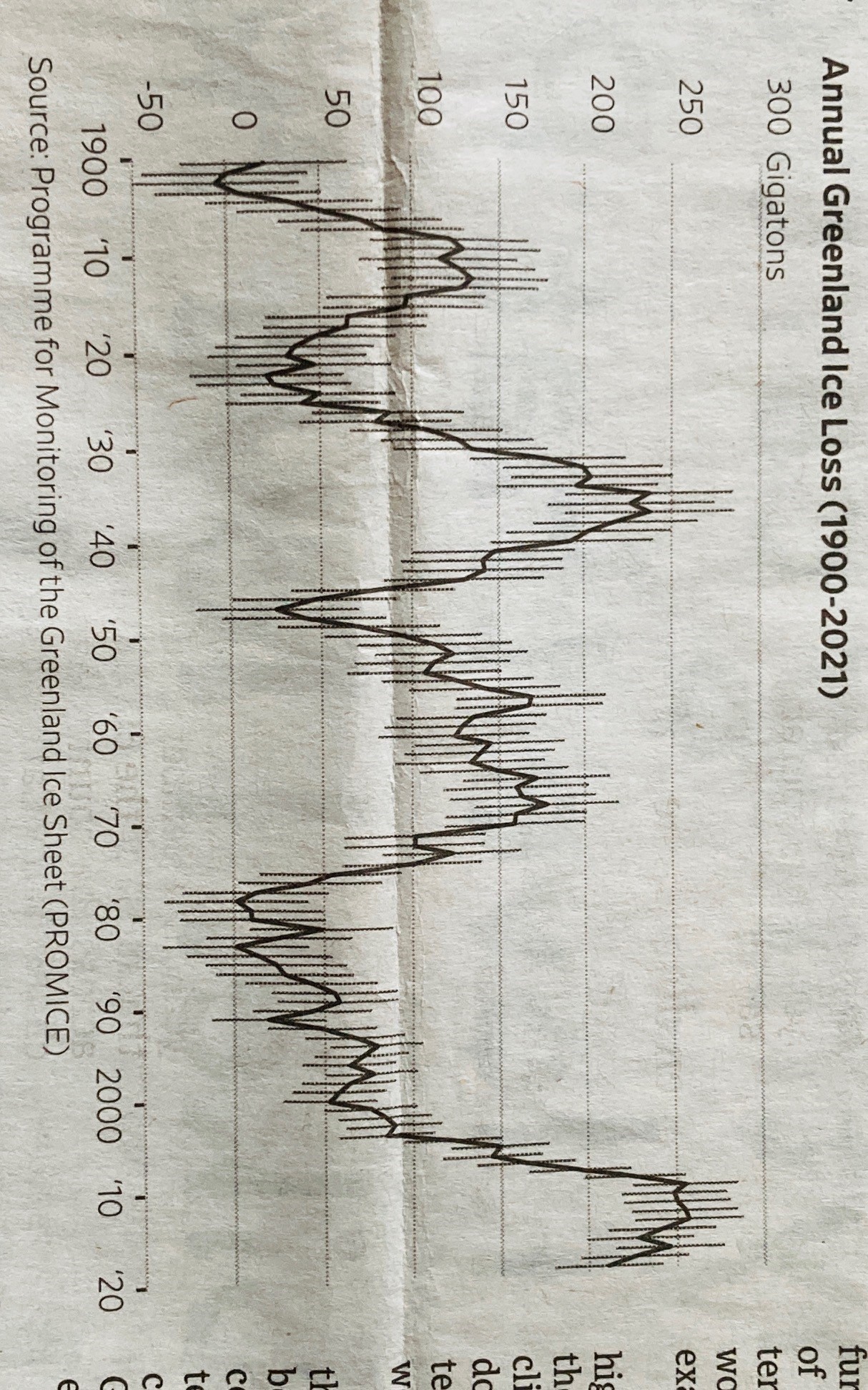
    March 1 update:  Here is the Greenland chart that is referenced in the comment section.

    Greenland ice melt2


  • There are plenty of people who foolishly believe we can build our way out of the so-called "housing crisis".  Dense development hasn't caused lower housing costs anywhere in the world–in fact, many of the densest locations are also the costliest.  And when the other quality of life components and job prospects are as good as the Bay Area, one would have to be extra foolish to try to out-build the demand and further diminish the quality of life.  But Sacramento has foisted SB 9 and SB 10 on us anyway.  Most of them couldn't get through Econ 101, but that is where we are at.

    The Burlingame City Council will discuss what to do about SB 10 tomorrow night.  The Staff Report is super thin on SB 10:

    SB 10. California Senate Bill (SB) 10 allows (but does not require) local agencies to adopt an ordinance to allow up to 10 dwelling units on any parcel if the parcel is within a transit-rich area or urban infill site. (Ed:  pretty much all of B'game).

    The General Plan Update has already provided a range of multiunit residential and mixed use land use districts with a wide range of residential densities, and the Zoning Ordinance Update underway will provide refined development standards for the corresponding zoning districts.

    Staff requests direction from the City Council on whether to pursue zoning allowed by SB 10.  Whereas SB 9-compliant zoning is required, municipalities may choose to adopt (or not adopt) SB 10-compliant zoning.

    And the report claims that neither SB 9 or SB 10 will have any fiscal impact!  It might be time to double-check the thinking on that since residential property taxes never cover the cost of providing city services–never mind the costs to the school district that is pretty much out of real estate.

    But let's look a little deeper courtesy of last Sunday's Mercury News piece with the sub-head "In an area noted for its booming economy, stunning weather and natural beauty, a majority feel their quality of life is in decline".  The Silicon Valley Leadership Group and the Bay Area News Group commissioned a survey by Embold Research to dig into this and it's not pretty.

    In a foreboding breakthrough, for the first time since the poll began posing the question in 2018 a solid majority — 56% — said they expect to leave the Bay Area in the next few years…a similar majority said the region is headed in the wrong direction.  In the survey of 1,610 registered voters, 71% said the Bay Area's quality of life has declined in the last five years.

    Two problems topped the list of increased concern being "serious or very serious"?  Drought (+41%) and Water Supply (+32%).  I'm glad to know I'm not alone on this.  The cost of housing was still the highest overall at 92% but only up 6%.  What if even half of the half of people that are considering leaving do so?  Even if it is only 10% that would be significant.   B'game has a huge amount of new housing already approved, in design and "in-the-dirt".  Maybe we should see how that all plays out?  I hope the council's direction to staff on SB 10 is a brisk, clear "forgetaboutit" so they can get back to ensuring our public safety, water supply, small business vitality, economic health and quality of life.

  • You could argue that the Covid pandemic is drawing to a close as we approach herd immunity and with it we will see a return to business and leisure travel.  With that a return of the hotel TOT that has been one of the Golden Geese keeping B'game flush would be in the cards.  Or not.  Maybe Zoom and work at home will take a serious dent out of travel.  For now though at least one erstwhile hotel developer on the Bayfront wants the freedom to build differently to attract life sciences tenants.  As this piece in the DJ notes, the Planning Commission is somewhat amenable as are some city councilors.

    With the pandemic interrupting the travel and hospitality industries, Burlingame officials are considering introducing the life sciences industry into an area historically preserved for hotels and light industry.  But they balanced those perspectives against an expectation that developers proposing life science buildings would be obligated to supplement their plans with an attractive package of community benefits.

    Under the proposal, buildings reserved for tenants in the life sciences industries could be allowed to build a floor-area ratio up to 3.0 — a significant spike from the current standard of 0.75 floor-area ratio for every building in the area other than hotels.

    And while support for the vision was broad during a challenging time in the travel and hospitality industry, officials also made clear they continued to prefer development of hotels along the Bayshore.

    Noting that hotel tax has been one of the city’s primary sources of income when the economy was thriving, Councilman Michael Brownrigg said he favored preserving incentives for future hotel construction.

    TOT has traditionally been about 38% of total city revenues in normal times as noted here back in 2016.  Nobody is suggesting tearing down existing hotels to change the usage, meaning that revenue stream should rebound, but may not reach the percentages of the past.  But the most interesting aspect of the proposal didn't make it into the DJ article.  I have it on good authority that life sciences companies need…..wait for it…..natural gas for their labs.  One source at Genentech called it a "deal killer".  Can the green councilors put aside their one-year old ban and grant a variance?   If one gets it, then the next one is entitled as well.  And if a company can get a variance for a big installation, will you be able to get one for a small installation?

  • A very quiet lawsuit filed by B'game against SFO and its owner, the City of SF, for causing the ground to sink in North B'game and along the Bayfront has been settled in B'game's favor.  Back in February, the SF Chronicle reported

    The entire Bay Area is plunging downward under the weight of its own sprawl. And that’s a concern as sea levels rise and cities try to figure out how they’ll stay above water in the coming decades. 

    Tom Parsons, a geophysicist with the U.S. Geological Survey, documented the problem recently. He calculated the weight of every building in the Bay Area and found the total to be so great, about 3.5 trillion pounds or the equivalent of more than 7 million Boeing 747s, that it’s pushing the Earth’s surface down. His research shows the region has sunk as much as 3.1 inches, on average, as a result of a century’s worth of development.

    “We’ve got all that fill on the bay that’s susceptible to being compressed, and we’re building on it, and we’re seeing some of the impacts of leaning buildings and subsidence,” Parsons told The Chronicle.

    But the key fact that led to the quiet legal action is

    Parsons did his research by tapping databases of Bay Area building sizes and figuring out the weight of the structures and their contents. As might be expected, weights were greatest in the downtown areas of San Francisco, Oakland and San Jose. Of nearly 1 million buildings evaluated, the heaviest was San Francisco International Airport.

    The weight calculation did not consider roads, bridges and other infrastructure, so the total is assumed to be a significant underestimate.

    The City has been worried about the impact of sea level rise on our Bayfront (noted here) and has expended substantial resources coming up with plans.  All of the additional building at SFO (the international terminal, the hotel and the new tower) is believed to have exacerbated the sinking–and made sea level rise more of a risk.  The settlement amount rumored to be in the neighborhood of $3.5 million will go towards reimbursing these expenses and further mitigation near our cash cow hotels.  Great work by the city staff getting SF to pay up!  Here is the map of building "subsidence".


    SF Chron Building sink
     

The Burlingame Voice

Dedicated to Empowering and Informing the Burlingame Community


The Burlingame Voice is dedicated to informing and empowering the Burlingame community.  Our blog is a public forum for the discussion of issues that relate to Burlingame, California.  Opinions posted on the Burlingame Voice are those of the poster and commenter and not necessarily the opinion of the Editorial Board.  Comments are subject to the Terms of Use.


All content subject to Copyright 2003-2026